When your organization changes, everything follows
ROK orchestrates business resources from a living organizational model: employees, contractors, documents, applications, access rights, workflows, and audit evidence.
Fewer silos. Fewer scattered resources. Greater operational control.
A living organization, not siloed tools.
A new hire, an internal move, or a departure triggers the right actions across the tools already in place. ROK connects them to your real-world organization, without replacing your HRIS, ERP, document management system, or IAM solutions.
Already deployed at Novares · 11 employee lifecycle workflows in production




The ROK platform
Orchestrate · Create · Secure
from a single organizational hub
01 · Orchestrate

Living organizational chart
ROK’s differentiating foundation.
The multi-axis organizational chart, synchronized with your HRIS and directories, anchors processes, access rights and compliance in your organizational reality.
02 · Create

Hyper automation
BPM, workflow and RPA in no-code, assisted by generative AI and an advanced rules engine.
Create your business applications, automate your processes, and move from natural language to an executable application.
03 · Secure

Native IGA
Identity governance and administration is natively integrated into the platform.
Because access rights stem from the organizational chart, security is architectural, not an added laye
Team Management
Manage · included in the hub
Kanban, Gantt, lean management: collaboration within the same organizational framework.
The fundamental difference
Two opposing philosophies
Gartner uses BOAT, Business Orchestration and Automation Technologies, to describe the attempt to orchestrate siloed tools. ROK offers a radically different answer: the organization as the single conductor.
Market vendors · Silo approach
The application first |
1
We create an application.
2
We assign roles to it.
3
We assign users.
4
We add security on top.
We orchestrate silos… as best we can.
ROK · Organization-centric approach
The organization first |
1
We model the real organization.
2
Each person exists with their role.
3
Tasks are assigned to people.
4
Security and compliance follow from it.
IGA is native, not an added layer.
The market suffers from silos and tries to orchestrate them. ROK solves the problem at the root:
When the organization is the conductor, silos no longer exist.
How does ROK eliminate silos?
The organizational chart as the single source of truth.
Connected in real time to your HRIS and directories. Hierarchical, matrix-based, functional, geographic.
BPM, RPA, no-code, AI: every process created knows the right stakeholders within the real organization.
Access rights stem from it too.
Native IGA: access rights are consistent by design, because they start from the organizational chart.
Result: zero silos, architectural security.
When the organization evolves, everything can follow: onboarding, mobility, departures, processes, access rights and the systems concerned.
The risk the market ignores
AI and no-code are multiplying security vulnerabilities
Every new no-code tool, every AI agent added in a silo creates new ungoverned access, newly exposed data, and new attack surfaces.
Market platforms accelerate this chaos. They do not solve it.
ROK is a structural response: every application inherits organizational governance. Security is not added afterwards, it is integrated from the start.
✓ Every application inherits governance
✓ AI agents within a defined scope
✓ Access aligned with the real organizational chart
✓ No orphaned access
✓ Compliance by design
✓ No security incident reported to date
✕ No organizational governance
✕ Ungoverned no-code applications
✕ AI agents with uncontrolled access
✕ Massive shadow IT
✕ Compliance impossible to audit
✕ Every tool becomes a new attack surface
What this changes in concrete terms
When the organization is in control,
everything becomes coherent
Because every process, every access right and every automation is anchored in the organizational reality, ROK eliminates the contradictions that others multiply.
Native IGA,
not added on
The organization defines who is who.
Access governance follows automatically.
Onboarding, mobility, departures: access rights follow real movements
Powerful
rules engine
For every task assigned to a person, advanced flow management conditions apply according to the real organizational context.
Controlled
AI
Multi-agent architecture, from the LLM to the interconnected application.
AI generates your applications from the organizational chart, without direct access to your internal data.
Compliance
by design
DORA, ISO 27001, GDPR.
Not through configuration, but through architecture.
Every workflow is compliant from the moment it is created.
Customer references
The ROK philosophy,
proven in the field
Complex and regulated organizations have chosen ROK to make the organization the foundation of their processes, access rights and compliance.
HSBC

Banking · 7,000 agents
A single organizational repository to align processes, access rights and compliance in a demanding banking environment.
Organization · Governance · Compliance
Elis

Services · 400 sites
SAP access governance driven from the ROK organizational chart, with consistent, auditable rights aligned with real roles.
Organizational chart · IGA · SAP · Audit
Novares

Industry · 21 countries
A living organizational chart to support the merger of two groups and unify structures around a shared backbone.
Org chart · Multi-country · Governance
Transdev

Transport · 300 entities
A shared repository to manage supplier administration, harmonize processes and secure business controls at scale.
Organizational chart · BPM · Suppliers
< 1 Month
to deploy ROK
75 %
lower operating costs
28
countries served
12 years
of R&D
Market positioning
ROK starts with the organization,
not the applications
Traditional platforms often automate an isolated component: workflow, application, ticket, access, or document. ROK connects the living organizational chart, workflows, and access rights so that every onboarding, internal move, departure, or contractor engagement triggers the right HR, IT, and security actions.
ROK does more than replace a tool:
it creates an operational link between the actual organization, processes, and access rights.
Platform capabilities
A single platform
to orchestrate your entire organization
From hyperautomation to access governance, ROK unifies your processes, applications and organization within the same secure foundation.
✓ Creation of dynamic organizational charts connected to roles, positions and responsibilities.
✓ Management of positions, skills and responsibilities in a single organizational repository
✓ Automation of employee journeys: onboarding, mobility and departures.
✓ Job descriptions connected to access rights, documents, applications and processes.
✓ Messaging and collaboration integrated directly into business processes.

✓ Centralized management of partners, suppliers and external stakeholders.
✓ Creation of secure portals and web apps to collaborate with your ecosystem.
✓ Real-time communication with partners through integrated messaging.
✓ Automatic triggering of workflows from incoming emails and events.

✓ No-code development of custom web and mobile applications.
✓ Use of generative AI to model applications, workflows and business rules.
✓ Orchestration and synchronization of data between applications.
✓ Real-time collection, use and monitoring of business data.
✓ Mobile applications integrating forms, photos and field workflows.

✓ Management of access, roles and rights from the real organizational chart.
✓ Automated provisioning of accounts, access rights and IT resources.
✓ Separation of rights based on positions, roles and responsibilities.

✓ Project steering through Kanban, Gantt, PERT and collaborative workflows.
✓ Integration of lean management principles to improve productivity and quality.

✓ Creation of interactive dashboards and real-time indicators.
✓ Tracking tools for full visibility into company performance.
✓ Smart alerts on deviations, risks and critical events.
✓ Connection to BI tools for detailed analysis.

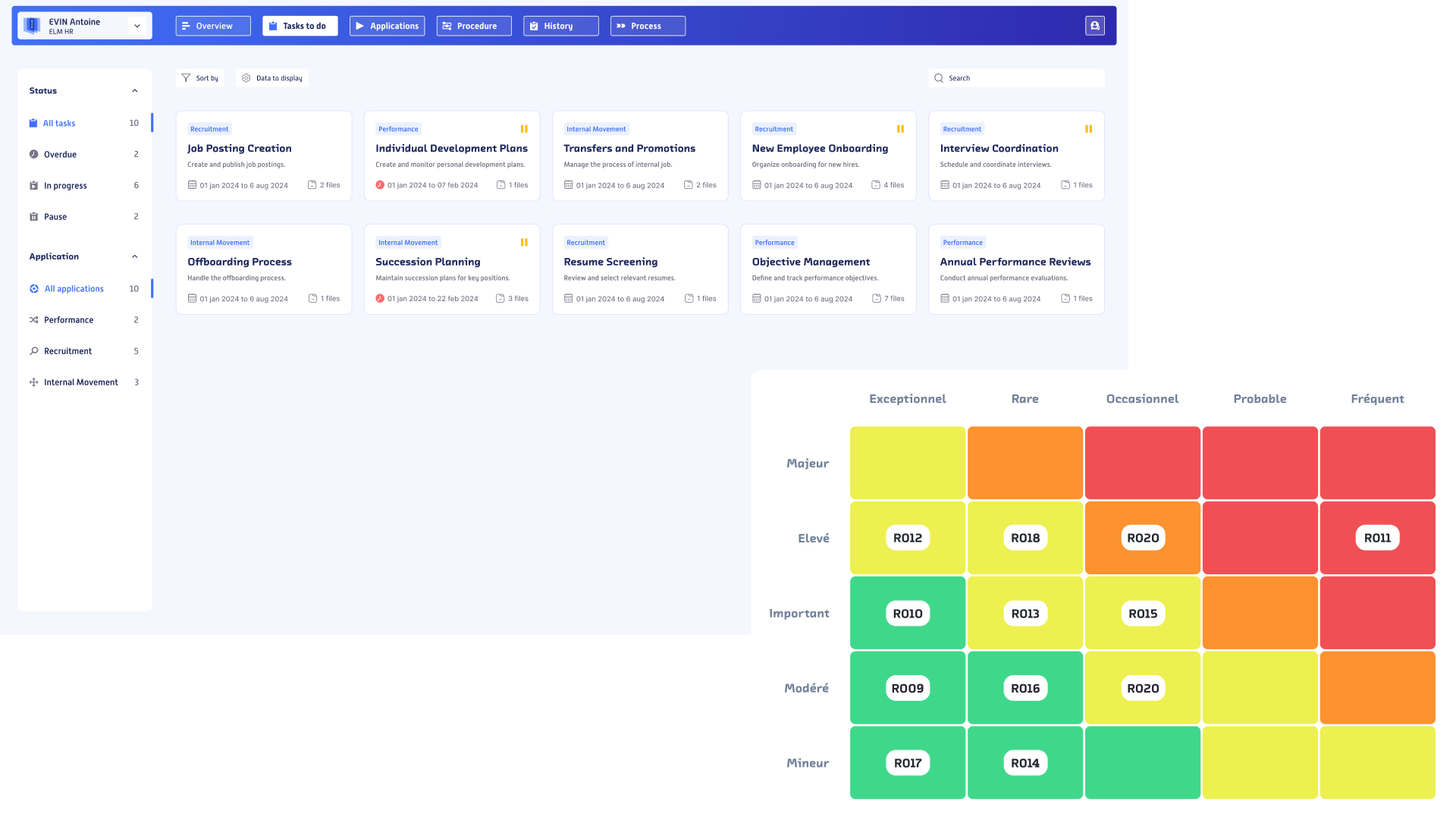
✓ Segregation of duties (SoD) and control of sensitive access.
✓ Management of audits, controls and regulatory requirements.
✓ Risk mapping to identify and assess potential risks.
✓ Compliance by design integrated into processes and access rights.
✓ Centralization of procedures, repositories and compliance documents.
✓ Integrated DMS with access control and versioning.
✓ Tracking of document deadlines and automatic alerts.
✓ Fast access to procedures through QR codes and mobile interfaces.
✓ OCR integration for automatic document analysis.

Ready to move from the tool to the organization?
Discover in 30 minutes how ROK unifies hyperautomation, the living organizational chart and native IGA in a single organizational hub.
ROK decoder:
Your questions,
our answers!
What differentiates ROK from other automation platforms?
Most platforms start from a tool or an application: a BPM, an RPA, a no-code tool, an AI or an IAM solution. ROK does the opposite. The platform starts from your real organization, with its people, roles and hierarchy, then derives processes, access rights and security from this same source.
This is what allows ROK not only to orchestrate tools, but to orchestrate your organization.
Why does ROK start from the real organizational chart?
Because the organization is the only stable foundation for knowing who does what, who validates what and who should access what. In ROK, the living organizational chart becomes the center of the system: it connects people, roles, processes, rights and compliance.
This way, when the organization evolves, processes and access rights can follow. This avoids having to manually recreate roles in every application.
Recommended link:
Living organizational chart
What is an organization-centric hyperautomation platform?
An organization-centric hyperautomation platform brings together automation building blocks, such as BPM, workflow, RPA, no-code and generative AI, but connects them to the real organization.
The goal is not to stack tools. The goal is to create, automate and secure business applications from the same organizational hub.
Recommended link: no-code hyperautomation and generative AI
Does ROK replace existing applications?
No. ROK does not require you to remove the applications already in place. The platform can integrate with your existing information system: HRIS, ERP, SAP, CRM, DMS, ITSM, directories or business applications.
ROK is used to structure, complete and orchestrate processes around your real organization, without imposing a full overhaul of your IS.
How does ROK eliminate silos?
Silos appear when each tool manages its own users, its own roles, its own rules and its own rights. ROK eliminates this logic at the root by using the organizational chart as the single source of truth.
Processes stem from it.
Rights stem from it too.
Security becomes architectural, not added afterwards.
How is ROK IGA native?
In ROK, native IGA is not a layer added at the end. It stems directly from the organizational chart. The organizational chart says who does what. IGA says who has access to what.
When a person joins, changes position or leaves the organization, their access rights can evolve according to their real role. This limits orphaned access, accumulated rights and provisioning errors.
Recommended link: dynamic orchestration of roles, identities and access
What happens during onboarding, mobility or offboarding?
In a classic approach, every HR movement requires tickets, approvals and updates in several tools. With ROK, the organizational movement can trigger the associated actions.
A new joiner can receive the right access rights.
A mobility can review old rights and assign new ones.
A departure can trigger the revocation of the relevant access rights.
This is the IN · MOVE · OUT logic, driven from the organization.
Can business teams create applications without creating shadow IT?
How is generative AI used in ROK?
Generative AI accelerates creation. It can help transform a business request into an application, with editable workflows, interfaces, forms and rules.
But AI does not replace governance. In ROK, it works within a structured framework: the application remains linked to the real organizational chart, roles, rights and security rules.
Why talk about architectural security?
Is ROK suitable for complex organizations?
Yes. ROK is designed for multi-entity, multi-site, matrix or hybrid organizations. The platform makes it possible to model complex structures, synchronize them with the HRIS and directories, then connect this organization to processes, rights and compliance.
This is particularly useful for groups, subsidiaries, site networks, international organizations or regulated environments.
What is the role of IT in ROK?
ROK does not bypass IT. The platform gives IT back a governance role. Business teams can create faster, but IT keeps control of the framework: security, rights, connections, rules, supervision and compliance.
The promise is therefore not “business teams replace IT”.
The promise is rather: business teams create, IT governs.
What is Team Management used for in the ROK hub?
Team Management makes it possible to manage projects, tasks, Kanban views, Gantt views and lean management within the same governed environment. The value is to avoid isolating project management in an external tool disconnected from the organization.
Teams, tasks and projects remain connected to the same organizational framework as processes and access rights.
Recommended link: agile team management
Why choose ROK now?
Because AI and no-code accelerate application creation, but they also increase risks if each tool operates in a silo. The more tools there are, the more access rights, exposed data and attack surfaces there are to govern.
ROK addresses this problem by starting from the real organization. The platform makes it possible to create faster, automate more broadly and secure from the start.
Let’s get started. Right now.
Learn more: organization-centric hyperautomation platform, living organizational chart and native IGA
Organization-centric hyperautomation platform: a new way to orchestrate the enterprise
An organization-centric hyperautomation platform does not simply add tools around existing processes. It starts from the real organization, meaning its people, roles, hierarchy and business rules, to create a common foundation between processes, access rights, applications and compliance.
With ROK, the goal is to go beyond siloed approaches. The BPM, RPA, workflow, no-code, generative AI and native IGA building blocks are brought together in a single platform, but they are not simply stacked. They are connected to the same starting point: the living organizational chart.
This logic makes it possible to create business applications, automate processes, assign the right roles and secure access within a coherent framework. To discover the creation and automation side, visit the dedicated page on no-code hyperautomation and generative AI.
Organization-centric hyperautomation platform and living organizational chart
ROK’s differentiator is based on a simple principle: the organization should drive the tools, not the other way around. This is why ROK relies on a living organizational chart, synchronized with your HRIS and directories, to maintain an accurate view of your organizational structure.
This dynamic organizational chart becomes a single source for understanding who does what, in which position, in which entity and with which reporting lines. It connects people to processes, rights, tasks, approvals and management rules.
Unlike a static organizational chart, the ROK organizational chart evolves with the company. Joiners, mobility and departures can update the structure and trigger the associated actions. To explore this dimension further, discover the organizational chart management page.
Organization-centric hyperautomation platform, no-code and generative AI
ROK enables business teams to create applications and automate processes without depending on a traditional development cycle. No-code gives users the ability to model workflows, forms, business rules and interfaces visually.
Generative AI accelerates this creation: it helps transform a business need into an operational application, with editable flows, interfaces and rules. AI does not replace no-code, it accelerates it within a controlled framework.
This approach is particularly suited to companies that want to digitalize business processes, automate approvals, reduce manual tasks and connect their existing applications. With ROK, workflow automation, BPM, RPA and the advanced rules engine remain connected to the real organization.
Organization-centric hyperautomation platform and native IGA
In ROK, identity and access governance is not a layer added afterwards. It stems directly from the organization. The organizational chart says who does what; native IGA makes it possible to know who has access to what.
This approach makes it possible to align rights with real roles, limit orphaned access, manage employee movements and strengthen compliance. When an employee joins the company, changes position or leaves the organization, access rights can follow the organizational movement.
ROK therefore facilitates access mapping, automated provisioning, rights review, SAP access management, SoD controls and decision traceability. To go further, visit the dynamic orchestration of roles, identities and access page.
Organization-centric hyperautomation platform and architectural security
In the age of AI and no-code, every tool added in a silo can create new ungoverned access, newly exposed data and new attack surfaces. An organization-centric hyperautomation platform addresses this risk by integrating security into the very structure of the application.
With ROK, applications, workflows and AI agents inherit the existing organizational framework. Access rights are aligned with the real organizational chart, actions remain traceable and approvals can be linked to the right roles. Security is therefore not only configured; it is carried by the architecture.
This logic supports compliance by design: every right, every approval and every action can remain connected to the organization, making it easier to audit, govern and control sensitive processes.
Organization-centric hyperautomation platform and team management
The organization is not limited to processes and access rights. It also concerns the way teams work, prioritize, track and deliver their projects. This is why ROK also integrates a Team Management dimension within the same governed environment.
With Kanban, Gantt and lean management views, teams can manage their projects without leaving the organizational framework. Tasks, responsibilities and approvals remain connected to the same logic of roles, entities and governance.
This continuity avoids multiplying external tools and makes it possible to maintain coherent management across organization, projects, processes and access rights. To discover this dimension, visit the agile team management page.
Organization-centric hyperautomation platform: BOAT, BPM, RPA, no-code, AI and IGA
The market is increasingly talking about BOAT, for Business Orchestration and Automation Technologies. This approach aims to bring orchestration, workflow, BPM, RPA, AI and no-code technologies closer together within more unified platforms.
ROK is part of this universe, but with a differentiating angle: the platform does not only seek to orchestrate tools. It starts from the real organization to eliminate silos at the root. Processes, applications, access rights and compliance stem from the same organizational hub.
This is the approach that enables ROK to bring together hyperautomation, living organizational chart, native IGA, advanced rules engine, controlled generative AI and architectural security in a single platform designed for complex organizations.