Team Management
Your projects, aligned with your actual organization.
ROK transforms your digital initiatives into clear, manageable and secure workspaces.
Tasks, responsibilities, documents, discussions, deadlines and decisions are not isolated: they remain connected to roles, access rights, business workflows and the actual organization.

Your projects move forward
But information gets scattered
Digital initiatives often start quickly, then become fragmented: emails, files, tasks, approvals, providers, meetings. The result: everyone is working, but no one truly sees the big picture.
What happens without ROK. |
1
Projects tracked across scattered tools.
2
Responsibilities with limited visibility.
3
Documents hard to find.
4
Delays detected too late.
5
External contributors integrated without a consistent framework.
Governance based on manual follow-ups.
What happens with ROK. |
1
Structured project space for each initiative.
2
Roles and responsibilities aligned with the organization.
3
Tasks, documents and decisions centralized.
4
Delays, alerts and dependencies visible.
5
Internal and external teams within a secure framework.
Continuous project governance.
Your teams collaborate. ROK structures and secures.
One platform
Three reflexes to manage your initiatives
ROK helps your teams turn a scattered initiative into a clear, monitored and governed project.
1
Structure
A clear space to frame each initiative, bring the team together, and centralize tasks, documents, objectives and decisions.
2
Coordinate
Visible and prioritized actions, managed with Kanban, Gantt / PERT, owners, deadlines, milestones and comments.
3
Govern
A secure framework: access derived from the organizational chart, rights governed by IGA, external providers integrated and a traceable history.
One project
One team
One source of truth
ROK transforms scattered projects into structured workspaces.
Each initiative has its own dedicated workspace.
Employees, business teams, IT, consultants, integrators and partners work within the same environment, with the right documents, the right tasks and the right access rights.
Objectives
The project framework is visible as soon as users enter the workspace.
Team
Internal and external contributors are identified, along with their role in the project.
Work in progress
Actions, deliverables and items to be produced are grouped within the same workspace.
Documents
Deliverables and reference materials are indexed, centralized and easily accessible.
Decisions
Alerts
Delays and bottlenecks become visible.
Track progress
Without losing sight of the bigger picture
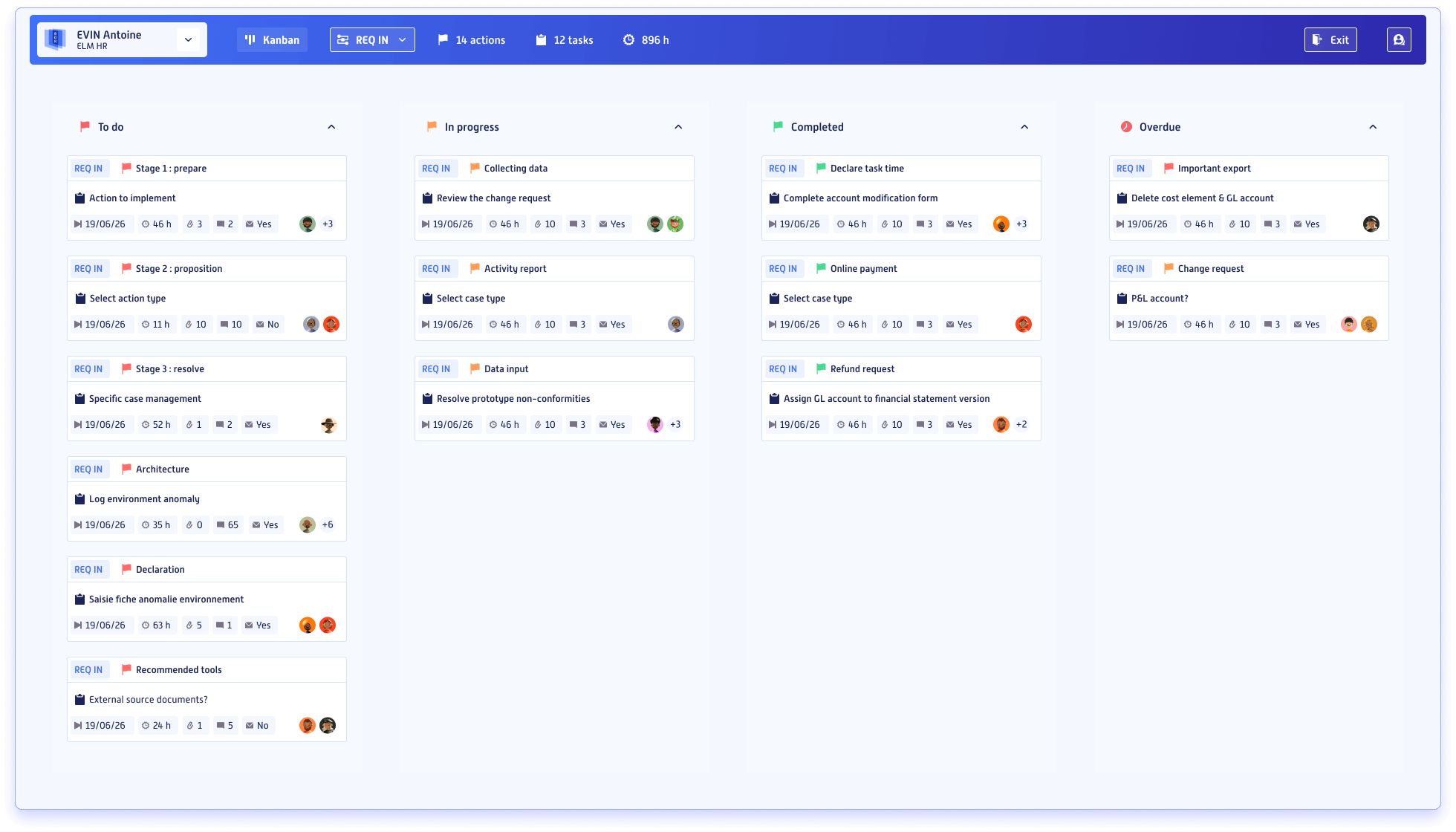
Kanban
Prioritize, move, track statuses and identify bottlenecks.
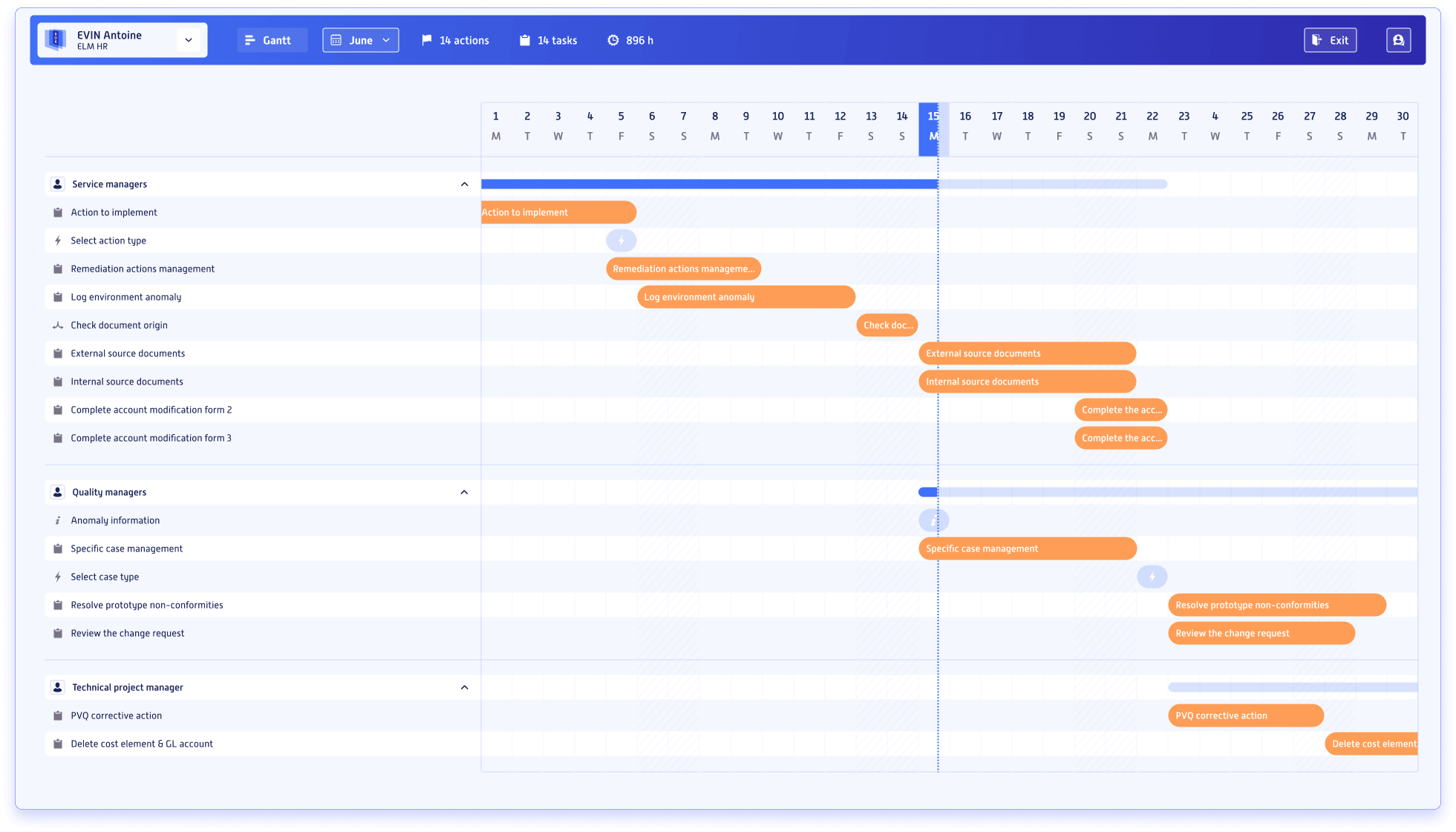
Gantt / PERT
Visualize deadlines, dependencies, milestones and the critical path.
Task list
Assign, comment, filter, archive, schedule and track every action.
Responsibilities
Identify who owns each action, along with their role, deadline and context.
Delays
Detect pending items before they slow down execution.
Milestones
Track key project stages and anticipate schedule slippages.
Communities
and project communication
Work with your teams, partners and service providers.
Complex projects rarely involve just one team.
ROK brings the right stakeholders together in a secure environment, with discussions connected to
the right project.
the right procedure.
the right workflow.
the right task.
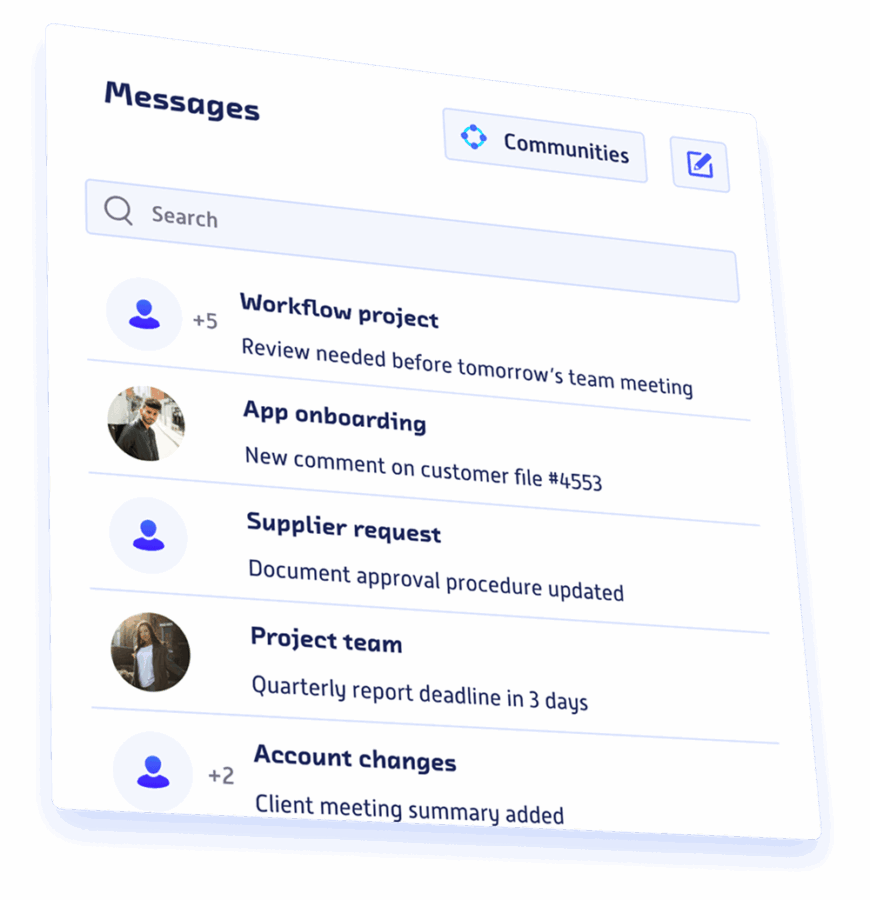
Project communities
Workgroups organized around an initiative, procedure, workflow or program.
ROK Chat
Discussions directly integrated into ROK, linked to a project, procedure, workflow or document.
Teams integration
A discussion can continue in a Teams meeting without losing context in ROK.
Mentions and notifications
Relevant contributors can be mentioned and notified to move work forward without manual follow-ups.
Access and confidentiality
Each participant only sees what is relevant to them. Documents, tasks and discussions remain within a controlled environment.
History
Discussions, actions and decisions remain available for consultation.
Document, retain, improve
Decisions no longer disappear
In ROK, comments, documents, alerts and approvals do not exist outside the project. They remain linked to the relevant tasks, deliverables and decisions.
What you avoid
Less fragmentation. |
Decisions lost in emails.
Documents shared in multiple versions.
Repeated manual follow-ups.
Meetings without operational follow-through.
What you retain
More context. |
Contextualized comments.
Documents linked to tasks.
Traceable approvals.
Actionable history.
Your projects no longer disappear in conversations.
They become a reusable knowledge base.
Your projects no longer disappear in conversations.
They become a reusable knowledge base.
Encourage initiatives
Keep governance under control
Your business teams move forward. Your organization stays in control.

Everything is connected
to roles
to access rights
to documents
to decisions
Visibility
Active projects, delays, dependencies and costs remain visible.
Governance
External participants, access rights and confidentiality remain under control.
Traceability
Decisions, approvals, comments and deliverables remain traceable.
Show us your most scattered project.
We'll show you how ROK transforms it into a clear, secure and manageable collaborative workspace.
Connected governance,
across the entire ROK ecosystem
Team Management connects your projects to the workflows, roles, access rights and execution experience already structured within ROK.

Living Org Chart
Project responsibilities are aligned with actual positions, teams, departments and entities.

Hyper automation
Projects drive the creation, evolution and documentation of business applications designed in ROK.

Native IGA
Access to documents, tasks and project workspaces is secured according to roles and responsibilities.
Team Management transforms collaboration into a managed, traceable and governed process.
ROK Decoder
Your questions,
our answers
Simple answers to understand how Team Management structures, secures and manages your collaborative projects.
Does Team Management replace a traditional project management tool?
No. ROK Team Management does not compete with Asana or Monday. It does something different: it connects your projects to your actual organization, your access rights and your business workflows.
Can you manage a project with internal and external teams?
Yes. You can bring together business teams, IT, consultants, integrators, software vendors or partners in a secure project workspace, with access adapted to their role.
Does ROK offer Kanban, Gantt and PERT views?
Yes. Team Management lets you track progress with visual views such as Kanban, Gantt and PERT, to prioritize actions, monitor deadlines, identify dependencies, visualize milestones and better coordinate owners.
Are project documents centralized?
Yes. Deliverables, reference materials, comments, approvals and decisions remain linked to the project. Information no longer gets scattered across emails, shared folders and meetings.
How does ROK secure collaboration?
Access rights are linked to roles and responsibilities. Each participant only sees what is relevant to them, whether they are an internal employee, consultant, integrator or partner.
Can you communicate directly in ROK?
Yes. Discussions can be linked to a project, procedure, workflow or document. Relevant contributors can be mentioned and notified to move work forward without manual follow-ups.
Does Team Management help create workflows?
Yes. Team Management helps manage, document and coordinate the creation or evolution of workflows and business applications designed in ROK. To learn more, visit the No-code hyperautomation and generative AI page.
Is Team Management connected to other ROK building blocks?
Yes. Team Management works with Hyperautomation, the Organizational Chart and IGA. Projects remain connected to the workflows, roles and access rights already structured in ROK. You can also visit the Organizational chart management and Dynamic orchestration of roles, identities and access pages.
Let’s get started. Right now.
Learn more: Team Management and agile team management
Agile team management: optimizing organization and collaboration
In a context of digital transformation, agile team management has become a key pillar for organizations looking to improve performance and streamline operations. Through integrated Kanban, Gantt, PERT, and strategic management capabilities, managers can monitor, adjust and coordinate activities in real time. This orchestration improves visibility into responsibilities, supports effective internal communication, and contributes to operational efficiency.
The digitalization of team management makes it easier to distribute tasks, identify bottlenecks and respond quickly. Thanks to integration with existing IT tools, teams no longer need to switch between multiple platforms. This workflow fluidity improves team productivity while maintaining a high level of oversight. Project management is therefore built on reliable processes aligned with business objectives.
Integrated tools also support employee engagement. By visualizing assignments, progress and deadlines in a clear interface, team members can better prioritize their work and collaborate autonomously. This task orchestration is essential for maintaining momentum, even in hybrid or distributed work environments.
This approach fits within a broader vision of Hyperautomation (workflow orchestration, BPM, RPA, AI and no-code), connecting tasks, users and processes without friction.
Project management: Kanban, Gantt, PERT and operational tracking
Agile team management relies on precise tracking of responsibilities and workload. Managers can quickly adjust assignments and evaluate progress through automatically updated indicators. This real-time task tracking makes it easier to identify deviations and allocate resources where they are most needed.
Successful collaborative management depends on smooth project coordination and tools designed to strengthen collective intelligence. The Kanban system provides a clear overview of ongoing, pending and upcoming actions. Gantt planning structures deadlines through a visual and forward-looking timeline. The PERT view complements this perspective by helping teams visualize dependencies, milestones and critical paths.
Organizations can also rely on advanced reporting tools to measure outcomes, adjust efforts and anticipate future needs. Through automated data analysis, collaborative management becomes proactive. It enables workload management and task allocation aligned with the actual capacity of each team.
This level of governance is strengthened by intelligent organizational chart management, ensuring consistency between roles, hierarchy and operations.
Agile team management within a broader orchestration strategy
Agile team management is part of a broader strategy for orchestrating human and digital workflows. Through BOAT (Business Orchestration and Automation Technologies), organizations benefit from a unified platform for assigning, supervising and optimizing collaborative work. This includes synchronization with enterprise cloud computing tools, ensuring accessibility and continuity across all work environments.
By automating interactions between employees, applications and business objectives, organizations improve performance optimization while reducing wasted time. Communication flows become centralized and structured, avoiding duplication and missed information. Process automation frees teams from repetitive tasks, allowing them to focus on higher-value activities.
Finally, agile team management helps strengthen compliance and security. The alignment between operational responsibilities and access rights is documented, automated and traceable. This is particularly valuable for internal audit automation and risk management, providing a clear mapping of actions and stakeholders.
This governance can also rely on dynamic orchestration of roles, identities and access, ensuring access rights are secured according to roles, responsibilities and organizational changes.
To go further, the Partnership Program and Strategic Partners expands the ecosystem through multiple integrations, accelerating the transformation of collaborative practices across the enterprise.
Agile team management and analytics for continuous improvement
The effectiveness of agile team management also depends on the ability to measure, analyze and continuously improve. This is where data collection and analysis become essential, enabled by integrated performance monitoring tools. By combining engagement indicators, task completion rates and deadline compliance, managers gain a comprehensive view of team productivity.
This data helps identify bottlenecks, redundancies and areas with excessive dependencies. Project analytics can suggest preventive actions such as workload redistribution or objective adjustments. This is a key component of a sustainable digital transformation strategy, giving decision-makers the insights needed to act quickly and objectively.
Agile project management is further strengthened by these analytical capabilities. By integrating operational feedback directly into planning cycles, teams can adapt efficiently to changing priorities. This agile framework prevents siloed execution and reinforces trust within teams. Process transparency enhances effective internal communication, a key driver of collective autonomy.
Ultimately, this approach supports a culture of continuous improvement in which every stakeholder actively contributes to optimizing working methods. Agile team management goes beyond day-to-day organization and becomes a driver of innovation, performance and competitive differentiation.