Document governance

The right document, to the right person, at the right time, fully secure.

Internally and externally, wherever they are. ROK natively indexes every document by everything that defines work itself: each person's place in the organization (company, site, business unit, function...), the flows it travels through (sales, purchasing, accounting...), the tasks it serves, the tools they rely on, down to the software, and the associated risks. With zero data entry.
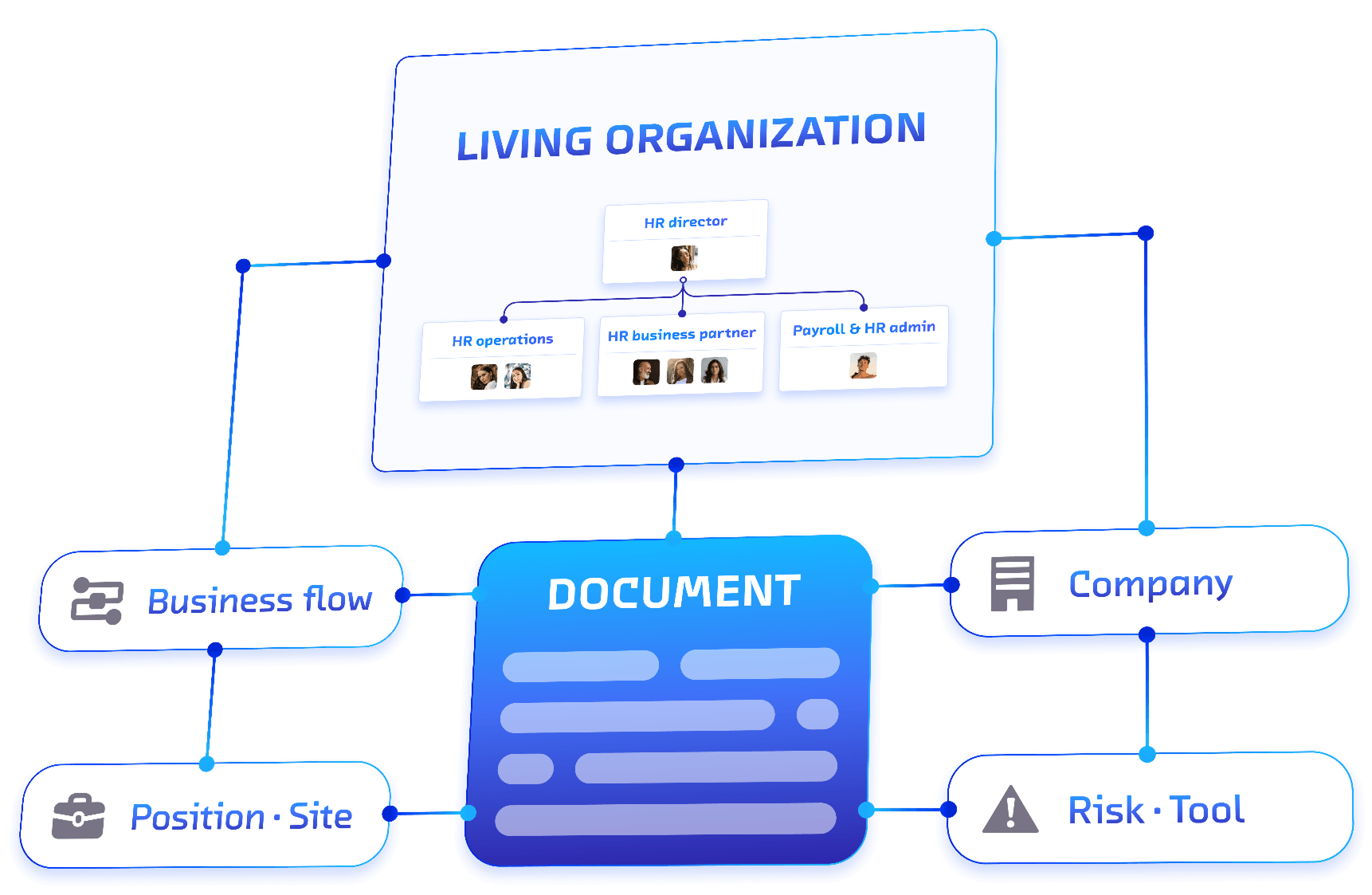
Diagram of the ROK Index document inheritance model connecting a task to documents, tools, IT rights, risks, workflows, processes, roles and the living organization.

The right document

multi-indexed, effortlessly.

To the right person, at the right time

internally and externally.

Anywhere, on any device

fully secure.

Enterprises don't lack documents.
They lack document orchestration. They lack document orchestration.

Enterprises don’t lack documents.

They lack document orchestration.

ECM systems store. ROK makes documents flow. ROK makes documents flow.

Today’s solutions are great at storing and retrieving documents. But they remain centered on the document itself, while organizations need to orchestrate its circulation through their business processes.

How ROK makes documents flow,
always to the right person.

ROK’s document management isn’t just another module: it emerges from two proven engines, serving one simple outcome.

ROK makes it flow

BPM engine: the document’s journey is described no-code, AI-assisted. Rule-based routing, the right person engaged at each step, annotations that trigger the next move, conditions and exceptions.

X X

ROK knows your organization

Living org chart: companies, sites, positions, functions, flows. Who is who, and where they sit in the organization.

= =

Superior document management

The right document, to the right person, at the right time, on the right device.

The document travels through the flow, and always knows who to reach because ROK knows everyone's place. It is thus natively indexed by the organization and the flows, with zero data entry. It is thus natively indexed by the organization and the flows, with zero data entry.

The document travels through the flow, and always knows who to reach because ROK knows everyone’s place.

It is thus natively indexed by the organization and the flows, with zero data entry.

The document inherits everything,
automatically.

The task is the pivot: it carries an IT right, a risk, and the document. It belongs to a typed flow, assigned to roles within the living organization.
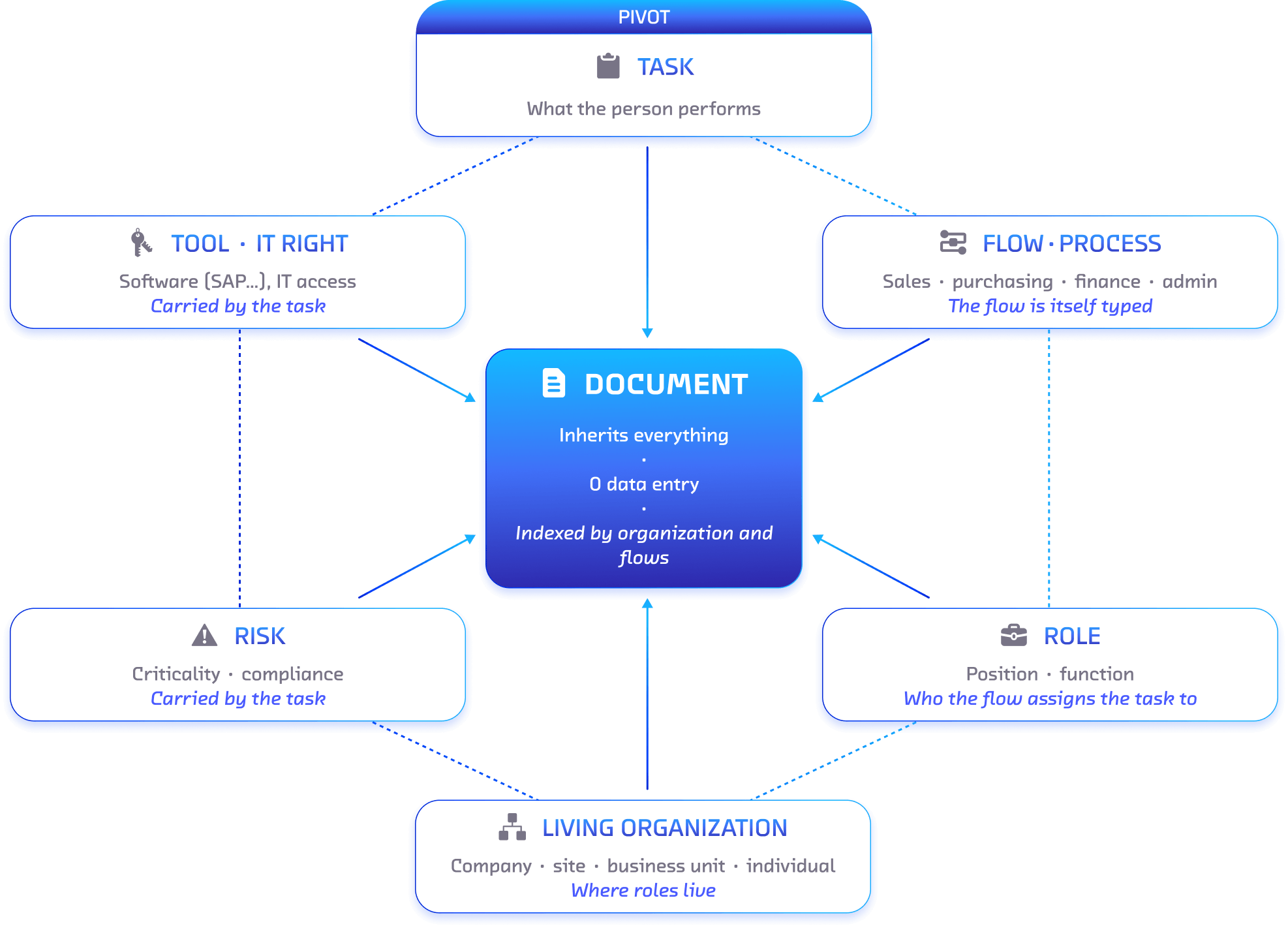
Diagram of the ROK Index document inheritance model connecting a task to documents, tools, IT rights, risks, workflows, processes, roles and the living organization.

You don't search for a document in a folder: you find it through its context. A tree structure remains possible, but optional. Indexing is unlimited: A tree structure remains possible, but optional. Indexing is unlimited:

You don’t search for a document in a folder: you find it through its context.

A tree structure remains possible, but optional. Indexing is unlimited:

Who

person, function

Which flow

sales, purchasing, finance…

Which task

activity performed

Which tool

software (SAP…)

Which company

site, business unit

Which position

role

Which risk

criticality

...no limit

any useful criterion

AI, in the right place

Others bolt on AI to reindex documents that were never classified.

At ROK Index, they are already multi-indexed by the organization & by the flows.

And we use AI where it actually creates value: reading inside a document to feed a process. For example, in a recruitment flow, drop in a CV and cover letter: ROK identifies the candidate, extracts name, contact details and skills, and pre-fills the next step’s form.

Everything you'd expect from a leading ECM,
and what ROK does with it.

Fifteen families, every criterion, its meaning and ROK’s answer.
Click a family to expand it.

Legend Differentiator Native Partial Soon Via partner
Capture from scanner/MFP
Bring in a scanned document (scanning is a hardware prerequisite).
Native
Frictionless ingestion via watched folder, email or API, then triggers the workflow.
Multi-format import
Ingest files of any type.
Native
Native storage in the ROK ECM on Azure, or in a piloted ECM (SharePoint, etc.).
Multichannel capture (email, web, API)
Automatically collect documents from multiple sources.
Differentiator
ROK orchestrates mail: an email from an identified sender triggers a workflow, fetches the attachment and stores it in the ECM.
Document recognition / data capture (IDP)
Identify the document type and extract its data.
Differentiator
OCR driven by the rule editor + structured extraction in production (automatic IBAN reading, ~1,000 supplier contracts/month, re-injection into the ERP).
OCR
Turn a text image into usable text.
Native
Third-party OCR engine driven by the ROK rule editor (in production).
AI-based data extraction
Read the content to pre-fill fields.
Soon
AI/LLM extraction from an attachment (e.g. CV → function, contact info) to pre-fill the next form. Rolling out.
Deduplication
Avoid duplicates at intake.
Native
Native filename uniqueness within a folder.
Filing plan / folder tree
Organize in a hierarchy.
Native
Folder tree available but optional: classification doesn't rely on it; organizational indexing makes it accessory.
Metadata-based indexing
Assign properties to retrieve documents.
Differentiator
Automatic indexing inherited from the flow: the document inherits the task's context (procedure, position, function, individual, site, BU, region, language…) with zero data entry.
Document typology
Define document families.
Native
Configurable object and form modeling.
Automatic context-based classification
File documents automatically.
Differentiator
Classified by the flow's organizational context (not by content), automatically and with zero entry.
Keywords, vocabularies, taxonomies
Standardize indexing vocabulary.
Native
Structured organizational reference data (positions, entities, functions).
Typed links and relationships
Connect documents in a qualified way.
Differentiator
Native modeling of objects, roles and relationships in the orchestration.
Full-text search
Search across full content.
Via partner
Content search via LLM reading (in progress). Native search runs on organizational axes.
Multi-criteria / faceted search
Filter by combined properties.
Differentiator
Multi-axis search on properties inherited from the position: function, risk, process, employee, department, BU, site… The richer the org chart, the more powerful.
Advanced search
Queries combining several conditions.
Native
Combined queries on organizational and process axes.
Preview without download
View without opening.
Via partner
No built-in preview today; viewing handled by the document tool.
AI / natural-language search
Query in plain language.
Soon
Querying a document's content via LLM ("does this document contain…?"). Rolling out.
Dashboards
Save queries, track KPIs.
Native
Native process dashboards.
Centralized, secure storage
Keep documents in a single repository.
Native
ROK ECM repository on Azure cloud, or piloted storage on SharePoint/other.
Lifecycle management
Drive from creation to archiving.
Native
Tracked from flow intake to archiving; full history kept, changes traced.
Automated retention rules
Keep/destroy by schedule.
Native
Per-document lifespan with expiry alerts (e.g. URSSAF certificate valid 3 months → alert at expiry).
Retention policies by type
Define durations per category.
Native
Retention rules configurable per type / per flow.
Volume management
Optimize storage footprint.
Deployment-dependent
Handled by Azure storage, to be specified per deployment.
Version management
Keep change history.
Native
The ROK ECM handles versioning and document history.
Lock / check-in–check-out
Prevent concurrent edits.
Native
Handled via rights and process states.
Version comparison
Visualize differences.
Via partner
Visual comparison delivered by the document tool.
Audit log
Trace who did what, when.
Differentiator
Fine-grained traceability across all actions; search by intake period (intake event is timestamped).
Timestamping
Reliably date events.
Native
Action and intake timestamps; qualified via third party.
Configurable approval circuits
Route a document along a defined path.
Differentiator
Heart of ROK's BPM engine.
Electronic signature folder
Group documents to be signed off.
Native
Native signoff circuit (legal-grade signature handled by an eIDAS third party).
Conditional workflows
Adapt the path based on conditions.
Differentiator
Rules engine and advanced orchestration.
Notifications and reminders
Notify and follow up with actors.
Native
Native in the workflow engine.
Delegation, escalation, absences
Handle substitutes and deadlines.
Differentiator
Coupled with the dynamic org chart: rights and tasks follow the function.
Progress tracking
See case status.
Native
Native process steering.
Task automation (RPA)
Run without human intervention.
Differentiator
Native RPA and hyperautomation (BOAT platform).
Secure internal and external sharing
Share with access control.
Native
Access automatically driven by the workflow (inherited from the task).
Co-editing and annotation
Work on a document together.
Via partner
Provided by office tools / the piloted ECM.
Collaborative workspaces
Group documents and people by project.
Native
Organizable via entities and processes.
Document comments
Discuss alongside the document.
Native
Comments at process-task level.
Secure third-party access
Give controlled access to outsiders.
Differentiator
Third-party access rights (members, suppliers) automatically driven by the workflow, just like internal users.
Electronic signature (eIDAS)
Sign legally online.
Via partner
Legally binding signature handled by a certified trust provider (DocuSign, Yousign…), orchestrated by ROK.
Multi-signer circuits
Get several people to sign.
Native
ROK orchestrates the circuit via API: sends to the signature provider and retrieves the signed document.
Qualified seals and timestamps
Guarantee legal origin and date.
Via partner
Provided by a trust services provider.
Invoice dematerialization
Send/receive compliant e-invoices.
Via partner
Out of scope; delivered by an approved PDP.
Mail dematerialization
Process mail digitally.
Native
Email capture (workflow trigger) and processing orchestration.
Fine-grained access rights
Precisely define who accesses what.
Differentiator
Rights granted to the POSITION. Onboarding/mobility/offboarding: automatic granting and revocation of documents and access tied to the function. Zero residual rights by design.
Strong authentication (MFA), SSO
Secure and simplify login.
Native
Handled by the identity / IGA layer.
Encryption (at rest and in transit)
Protect data.
Native
Platform standard.
Access segregation
Isolate sensitive perimeters.
Differentiator
Segregation by entity and by position; no residual rights.
Activity monitoring
Spot risky behavior.
Native
Access governance and review (IGA).
Backup and DR/BC
Ensure continuity.
Deployment-dependent
Depends on the chosen hosting.
Legally binding archiving
Preserve with legal guarantee.
Via partner
Via integration with a certified EAS / digital safe (distinct from versioning, which is native).
Standards compliance (NF, ISO)
Meet legal archiving standards.
Via partner
Delivered by the third-party archiving component.
Electronic archiving system (EAS)
Archive durably and legally.
Via partner
To be interfaced with an EAS.
GDPR compliance
Control personal data.
Native
Access/data governance simplifies compliance (DORA offer).
Reliable audit trail
Prove operation history.
Differentiator
Full traceability of access and actions, by organizational axis and by period.
Sealing and integrity
Guarantee non-alteration.
Via partner
Provided by the digital safe / EAS.
ERP, CRM, HRIS, payroll connectors
Talk to business software.
Differentiator
Multi-app orchestration and provisioning, core business (e.g. re-injecting data into the ERP).
Office integration (M365, Google)
Fit into daily tools.
Native
Connection to office suites.
Open APIs (REST) and webhooks
Programmatic exchange.
Differentiator
Open APIs at the heart of the orchestration platform.
Standardized import/export
Exchange in standard formats.
Native
Support for structured exchanges.
ECM/EAS interoperability
Plug into an existing document system.
Differentiator
ROK can drive an external ECM (SharePoint) while keeping its native contextual indexing.
Admin console
Manage the solution without code.
Native
Native centralized administration.
No-code / low-code configuration
Build processes without coding.
Differentiator
Native no-code/low-code studio, a major strength.
Dashboards and reporting
Measure and steer activity.
Native
Native process reporting.
Key performance indicators (KPI)
Track key metrics.
Native
Configurable process KPIs.
Multi-entity / multi-site management
Manage several organizations.
Differentiator
Dynamic multi-entity org chart (ref. Transdev 300 entities, Elis 300 subsidiaries).
Logs and supervision
Monitor proper operation.
Native
Technical logging.
Intuitive web interface
Use from a browser.
Native
Native web interface.
Mobile access (iOS/Android)
Work from mobile.
Native
Document access via mobile.
Remote / hybrid work access
Access remotely with security.
Native
Secure remote web access.
Multilingual
Multiple interface and flow languages.
Native
Natively multilingual platform: a cross-border workflow appears in each participant's language; documents managed in every language.
Accessibility (RGAA / WCAG)
Usable by everyone.
Deployment-dependent
Compliance level to be documented per project.
Ergonomics and adoption
Ease of use.
Differentiator
Near-zero end-user learning curve: complexity is owned once by the designer; the user manages no indexing, no filing, no search.
Automatic classification
File and tag automatically.
Native
Automatic classification by flow context; AI content classification as a complement (in progress).
Summarization and extraction
Synthesize and pull key data.
Soon
Via the LLM layer being rolled out.
Semantic search / assistant
Query in natural language.
Soon
Querying document content via LLM, rolling out.
Duplicate and sensitive content detection
Spot risky content.
Partial
Native filename uniqueness; semantic detection to be wired in.
Personal data anonymization
Mask sensitive data.
Partial
To be wired in per GDPR requirements.
Hosting and sovereignty
Choose hosting mode and location.
Native
French vendor; Azure cloud hosting; modes to be specified per need.
Performance and scalability
Hold up at scale.
Differentiator
Proven at scale (HSBC 7,000 agents, Novares 6,000 employees, Transdev 40,000 suppliers).
Availability (SLA)
Guarantee the service.
Native
Contractual SLA. (Data portability to be confirmed.)
Total cost of ownership
Evaluate the full cost.
Differentiator
Average license cost observed: ~€1/user/month, well below ECM standards (€5 to €65).
Support and enablement
Responsive support.
Native
Vendor enablement (French team).
Vendor longevity
Vendor strength.
Native
12 years of R&D, ROKe™ patent, large-account references (HSBC, Transdev, Novares, Elis).

Security follows the function,
in real time.

Access is born and dies with the function, never with the person. The same rigor as your IT access, applied to every document.

Security through the function |

01 · Principles

Four guarantees applied to every document, in real time.

Access through the function

Zero residual rights

Encryption & MFA/SSO

Full traceability

For your entire ecosystem |

02 · Ecosystem

The right document reaches every concerned audience, and only them.

Internal employees

everyone sees the documents tied to their function.

Partners & contractors

external access limited to their mission

Members & network

the right population receives the right content.

Always maximally secure

removed the moment the function or mission ends.

We replace nothing, we sit on top. |

03 · Covered sources

ROK has its own ECM, but can also drive yours (intranet, extranet, other ECM) without moving anything, adding this dynamic, real-time security.

ROK ECM

native storage on Azure.

Your existing ECMs

SharePoint and others, piloted.

Intranet

secure distribution.

Extranet

third parties, partners, member.

The same engine |

ROK applies to your documents the intelligence it already applies to your IT rights.

An IT right

= Task → Role → Process

A document

= Task → Role → Process

Proven at scale,
on a mature platform.

ROK Index isn’t a new product to validate: it’s the application of a platform already in production for document governance at some of the most demanding organizations.

HSBC

hsbc

Banking · Regulation · 7,000 agents

Entire regulatory document base, thousands of procedures. Front / back office segregation, validated by HSBC cybersecurity and an external audit.

Coface

coface

Credit insurance · Risk

Risk and claims management: each expert sees only their cases. SharePoint kept as storage, governed by ROK.

Novares

novares

Industry · HR & sales · 21 countries

Recruitment: CV reading and case pre-filling. Sales process steering on the living org chart.

Transdev

transdev

Mobility · Procurement · 300 entities

Supplier contracts: ~1,000 per month carried by the flow; OCR reading of IBANs and ERP update.

12 years

of R&D and continuous production on the platform

30 000

users governed on a single deployment

28 countries

covered by one international deployment

thousands

of procedures and documents governed and steered

"Gartner classifies the ROK platform in the BOAT family (Business Orchestration & Automation Technologies); Marc Kerremans proposed a dedicated framing, RAO: Resource Automation & Orchestration. ROK Index is its document-side expression."
Marc Kerremans
Gartner Analyst

Living organization

Business & relational flows

Real-time rights

No-code

AI reading & extraction (IDP)

The right document, to the right person, fully secure, wherever they are.