
Hyper automation
Create your business applications - Automate your processes - Interconnect your systems.
Without a single line of code. Without a single line of code. |
ROK gives your business teams the ability to create, deploy, and evolve their own applications without relying on IT, without delays, with AI as a native accelerator.
Customer proof
Transdev automates its supplier master data with ROK
No-code application · Approval workflows · OCR/RPA · ERP integration · More than 1,000 requests processed per month.
Your business teams have needs
IT has other priorities
Your business teams create. Your IT governs.
What happens without ROK. |
Key processes remain manual due to lack of available IT resources.
Excel files circulate where business applications should exist.
Development timelines stretch projects over months.
Prolific Shadow IT creates compliance and security risks.
Each change requires a full development cycle.
What happens with ROK. |
Business teams create their own apps in just a few days.
IT retains governance, access rights, and security.
AI generates procedures, rules, and forms in just a few clicks.
Processes are automated without coding, without an integrator, without tickets.
Each business change is deployed autonomously.
One platform
Three capabilities
1
Native No-Code
Create applications and processes visually, without writing a single line of code. Accessible to business teams.
2
Built-in Generative AI
Describe your need in natural language. ROK generates the application, interfaces, and rules for you.
3
Workflow engine
BPM, business rules, validations, exceptions: the most complex logic, configured visually.
Create your business applications
in 4 steps
ROK transforms a business need into an operational application in just a few days. The logic is visual, progressive, and requires no technical skills.
From idea to deployment. Without a developer. |
1
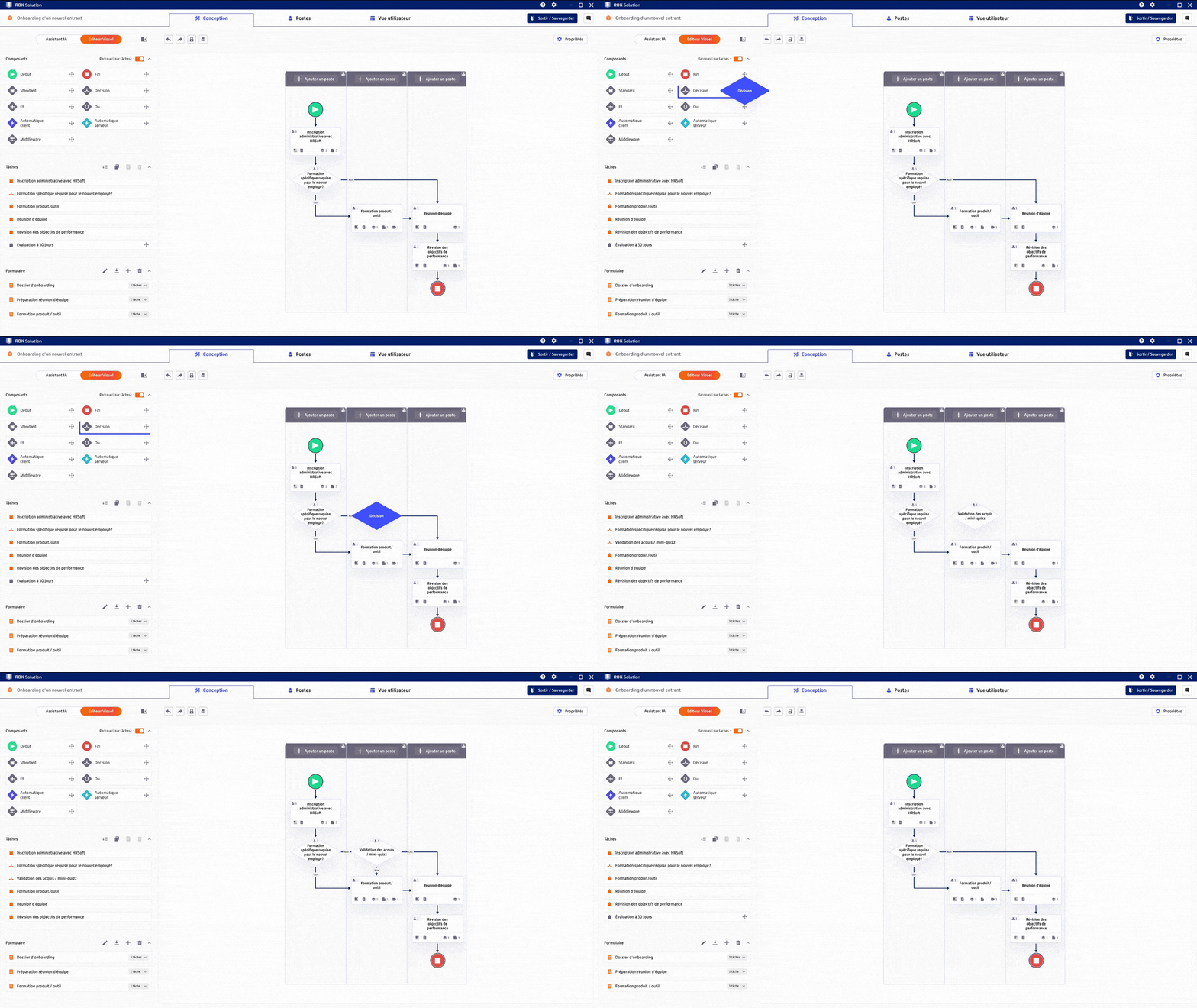
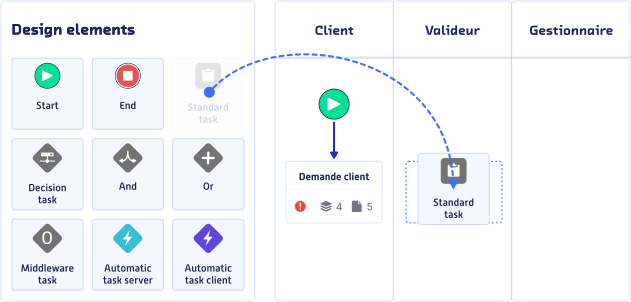
Draw your flow
Structure your steps, validations, and exceptions in a visual drag-and-drop flowchart. No code, no syntax to learn.
2
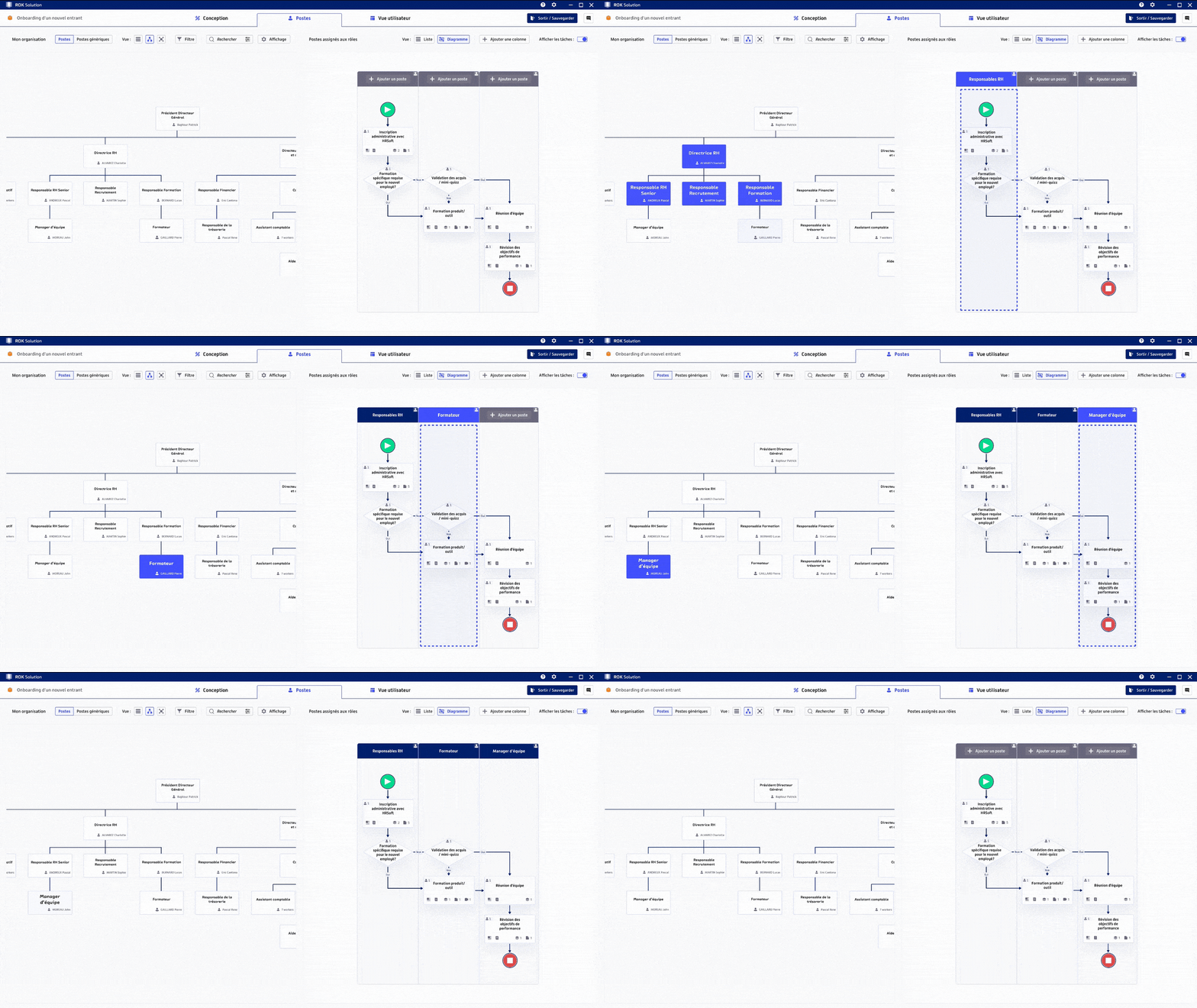
Assign roles
Define who is involved at each step: decision-makers, approvers, executors. Responsibilities are clear and traceable.
3
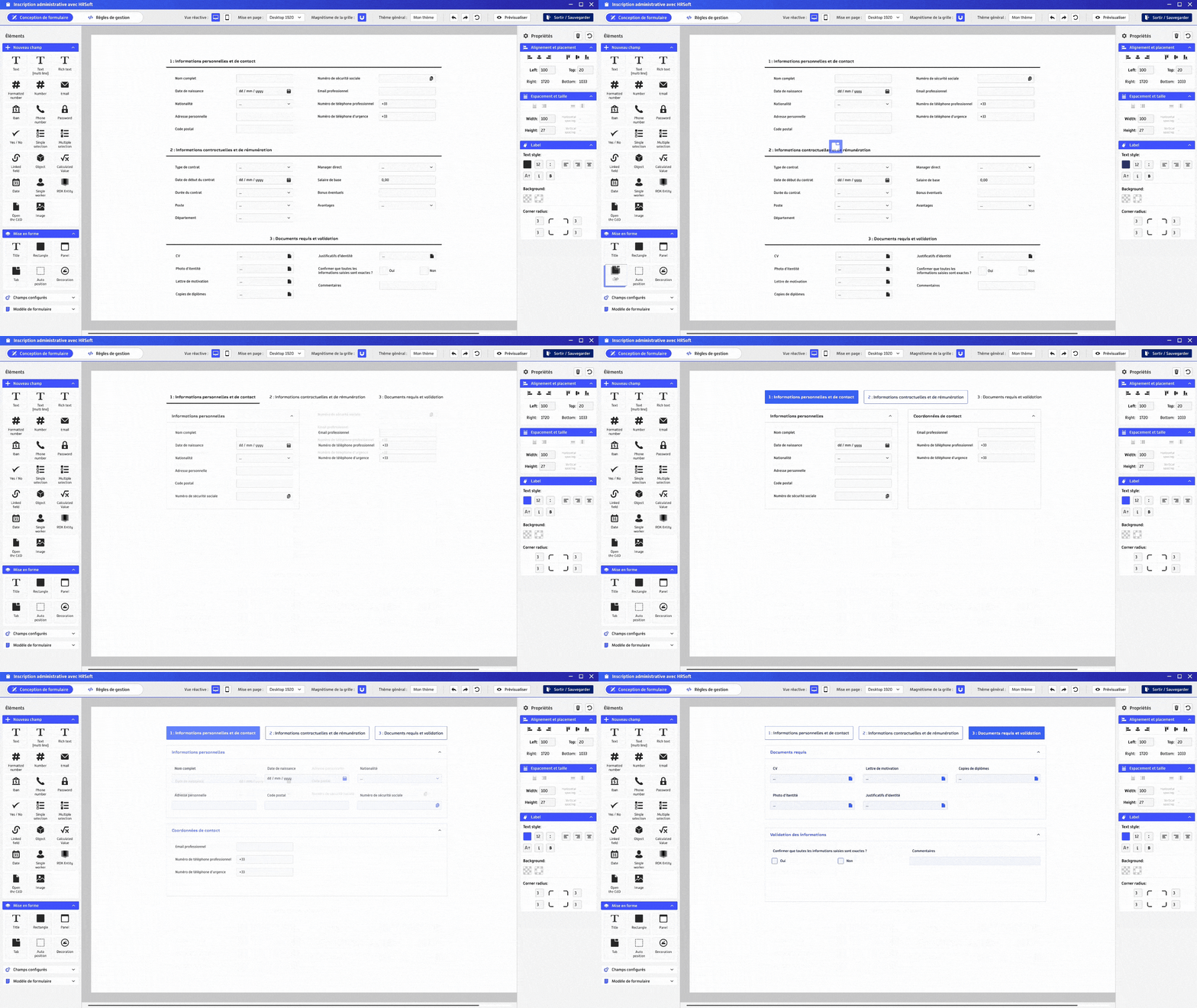
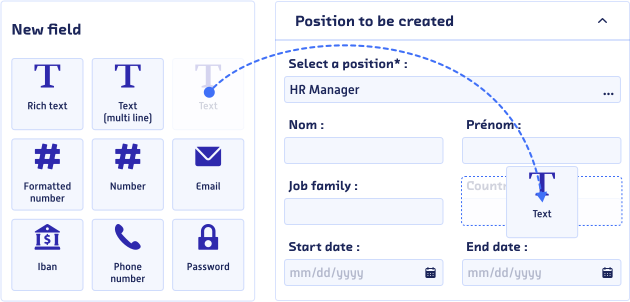
Design your interfaces
Create the forms and screens your users need, visually, without coding any integrations.
4
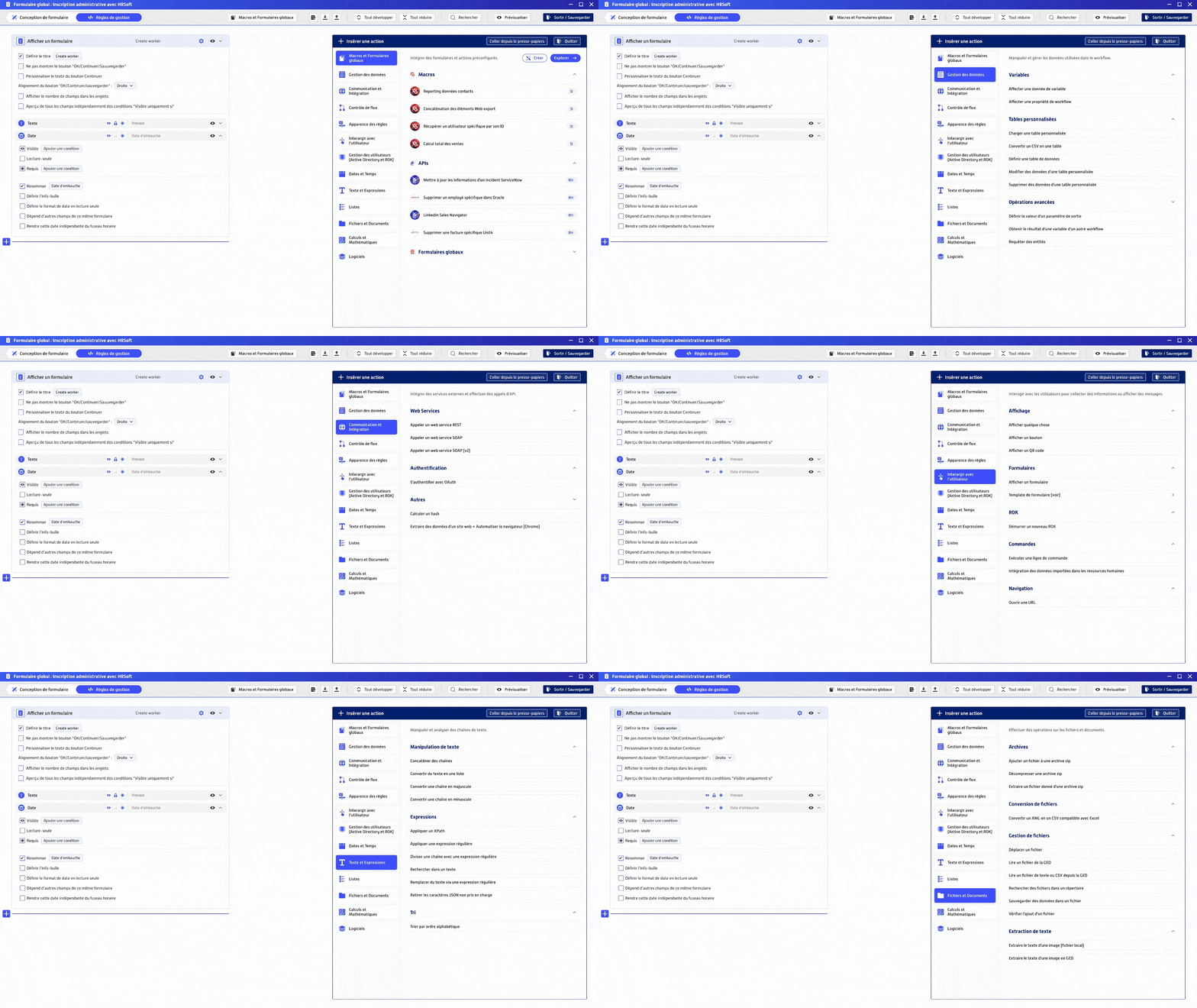
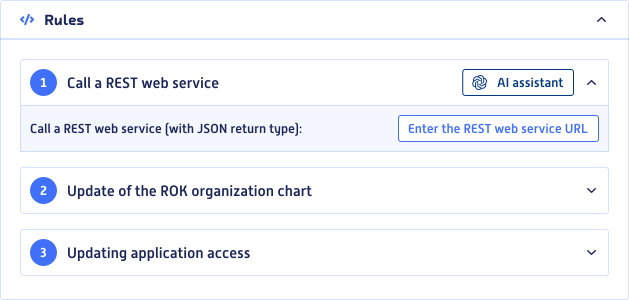
Define your rules and connect
Configure business logic, alerts, and exceptions. Connect your apps to existing tools (ERP, CRM, HRIS).
From idea to application
in 30 minutes
Describe it. ROK builds it.
ROK’s Generative AI is not an assistant.
It is a master builder.
It is a master builder.
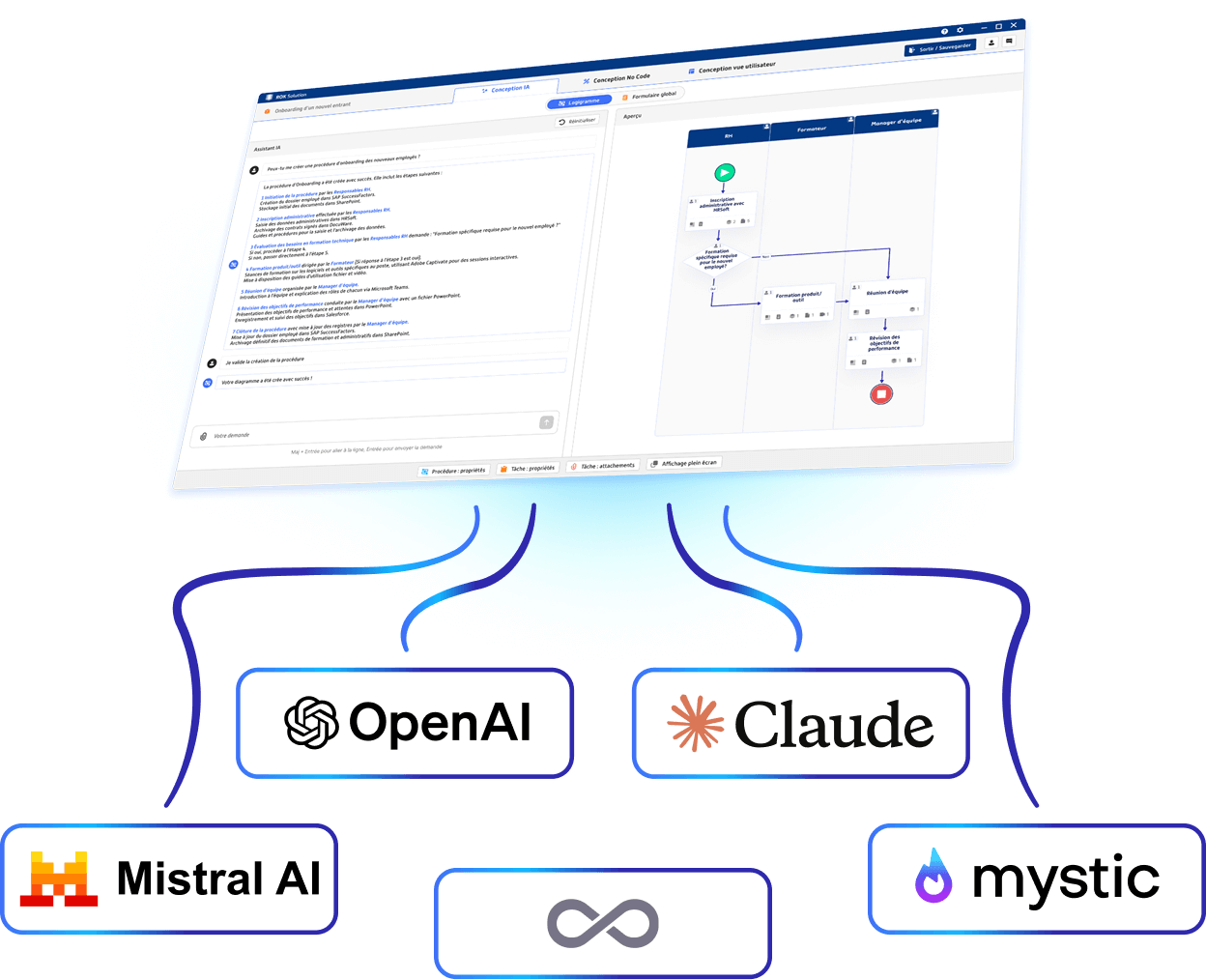
Describe your need in natural language: an approval process, a request form, a tracking application, and ROK generates the complete application: flows, interfaces, rules.
Complete workflows
Steps, validations, exceptions, automatically structured.
User interfaces
Forms, screens, dashboards tailored to each role.
Business rules
Conditions, alerts, escalations, calculations.
Built-in documentation
Automatically generated with each app creation.
AI does not replace no-code.
It accelerates the work, which remains
controlled editable evolvable by your teams.
Do you want to see this on your own process?
Do you want to see this on your own process?
The power
under the hood
No business complexity can stand in your way.
ROK no-code is not a prototyping tool.
It is a complete business rules engine.
It is a complete business rules engine.
Capable of modeling processes as complex and specific as those handled by your ERP or ITSM solutions.4
Business logic
Conditional rules, branches, and exceptions.
Task automation
RPA integration for repetitive tasks.
System integration
Integration via APIs and various connectors.
Approval workflows
Multi-level validations with full traceability.
Alert management
Automatic escalations and configurable alerts.
Monitoring and control
SLA management and processing times.
Complete history of actions and decisions.
Manage everything
Wherever you are
Your applications and processes, accessible ATAWADAC.
Any
Time
Where
Device
Content

ROK dashboards adapt to each role, each device, and each context. From executives tracking their KPIs on the go to operational teams handling requests in the field.
Any
Time
Where
Device
Content
Real time
Live monitoring of ongoing processes, pending validations, and active alerts.
Multi-device
Interface adapted for desktop, tablet, and mobile. Same app, same experience.
By role
Each employee sees only what concerns them, based on their rights and responsibilities.
Designed for the enterprise
Not for prototyping
Your business teams create. Your IT controls.
ROK is not a Shadow IT tool.
It is a governance framework controlled by IT.
It is a governance framework controlled by IT.
Each application created is integrated into a strict environment, where access rights, traceability, and connections to the information system are controlled at every step.

Connection to existing IT systems
ERP, CRM, HRIS, ITSM, and directories connected via standard connectors. No overhaul required.
Security & governance
Access rights aligned with the real organization, full traceability, centralized monitoring.
Time-to-value
From idea to production in just a few days. Less dependency on IT. Greater business agility.
ROK vs other solutions
BPM, RPA, Low-Code, No-Code, AI
Without code. Without code. |
ROK goes beyond traditional No-Code
ROK simplifies and accelerates automation
ROK unifies processes, governance, and execution
Show us your most complex process.
We show you how ROK solves it in 30 minutes.
ROK Decoder:
Your questions,
our answers!
No-Code, generative AI and hyperautomation often raise the same questions: integration, security, business autonomy, complexity and the role of IT. Here are the key answers to understand what makes ROK different.
What is hyperautomation, and why now?
Hyperautomation means combining several building blocks such as No-Code, workflow, BPM, RPA, business rules and generative AI to automate business processes more broadly. Today, organizations need to move faster, reduce manual work, integrate their tools more effectively and give business teams more autonomy without losing control. That is exactly where ROK creates value.
How is ROK different from a traditional BPM tool or an RPA tool?
A traditional BPM tool models processes. An RPA tool automates specific tasks. A No-Code platform often allows users to create forms or simple applications. ROK brings these dimensions together in a single platform: business applications, workflows, BPM, business rules, interfaces, integrations and generative AI. The goal is not just to automate one task, but to design, execute and continuously evolve a complete process within a consistent framework.
Can my business teams really create applications without IT?
What kinds of business applications can be built with ROK?
With ROK, you can quickly create and evolve a wide range of business applications: HR onboarding, approval workflows, internal forms, quality procedures, compliance processes, action tracking, corrective action plans, finance, IT, procurement and support workflows, as well as master data repositories and cross-functional applications. The platform then allows you to execute, trace, monitor and continuously improve these applications over time.
Why combine No-Code and workflow in the same platform?
A workflow on its own mainly orchestrates steps and approvals. No-Code also makes it possible to create the interfaces, forms, business rules and applications around that workflow. With ROK, these dimensions work together in the same platform. This avoids breaks between modeling, execution and business usage, and makes processes more consistent, faster to deploy and easier to evolve.
How does ROK integrate with our existing information system?
ROK is designed to integrate with what is already in place, without requiring a full rebuild. The platform can connect to environments such as ERP, CRM, HRIS, document management systems, ITSM and other business applications through APIs, web services, MCP, OCR and other connectors. The goal is not to replace your ecosystem abruptly, but to orchestrate flows, fill in what is missing and make processes run more smoothly.
Does the AI generate code, or does it work only in No-Code mode?
In ROK, generative AI acts as a creation accelerator within a No-Code approach. It can generate an initial working base from a need, a text or a document: flows, interfaces, forms and business rules. Then the user takes control again in the visual studio to adjust the design, refine the rules and complete the application. The objective is not to generate raw code, but to make design faster and more accessible.
Can applications created with ROK really be customized?
Yes. ROK is not limited to fixed templates. The platform allows you to create custom interfaces, build forms tailored to business needs, adjust business rules and evolve the application over time. Generative AI can accelerate the initial creation, but you keep control in the No-Code studio.
What makes the ROK rules engine different?
The ROK rules engine allows you to define conditions, business paths, controls, calculations and dynamic behaviors without coding. It can also manipulate data and connect processes to other tools. It is a core component of hyperautomation, capable of handling complex scenarios in a visual and usable way.
Is No-Code compatible with security and governance requirements?
Yes. ROK follows a secure by design and compliant by design approach. Access rights are aligned with the organization, traceability is ensured and connections are controlled. The goal is to enable autonomy without creating shadow IT.
Is ROK only for designing processes, or also for executing them?
ROK covers both. You can design, execute, monitor and evolve your processes within the same platform. It supports the full lifecycle from idea to operational execution.
How long does it take for a non-technical team to learn ROK?
The learning curve is short compared to traditional tools, because ROK is based on a visual, progressive and No-Code approach. Business teams can quickly understand how to model a flow, design a form and define rules. Generative AI further accelerates adoption by providing an initial base that can be easily adjusted.
Let’s get started. Right now.
Learn more: No-Code, Generative AI, Hyperautomation (workflow, BPM, RPA, AI)
No-code and hyperautomation: create, optimize, and automate your applications without development
The duo of no-code and hyperautomation (workflow, bpm, rpa, ai) is disrupting the way companies design, adapt, and manage their business processes. It’s no longer just a tech trend—it’s a structural revolution. By enabling application creation without development, this approach redefines roles within the organization: business teams become active agents of transformation, with no technical dependency.
The strength of the AI-assisted No-Code platform lies in its ability to connect, automate, and orchestrate complex tasks. It relies on an orchestration engine to automate your processes, based on open standards and capable of interacting with all components of the information system. Thanks to application interconnection via APIs and web services, the company operates intelligent and secure workflows.
By combining no-code development, artificial intelligence applied to No-Code, and complex process modeling tools, this solution ensures long-term organizational agility. All within an intuitive interface that simplifies business rule configuration, data management, and user experience customization.
To learn more, explore the full approach to hyperautomation (workflow orchestration, bpm, rpa, ai, no-code) behind this silent revolution.
No-code and hyperautomation serving operational performance
Adopting no-code and hyperautomation (workflow, bpm, rpa, ai) means building a system capable of responding to the unexpected with precision. Automation is no longer rigid—it becomes adaptive, contextual, and fully focused on the end user. The goal: to simplify, secure, and accelerate business workflows. This approach to workflow automation drastically reduces processing time and application maintenance costs.
One of the pillars of this approach is the personalization of business processes. Every workflow, form, and interface can be configured to reflect the realities of a specific job function or industry. IT digitization thus becomes a key differentiator. And with integrated predictive analytics, operational decisions are based on real trends rather than static rules.
The platform also leverages advanced modules such as OCR and intelligent recognition, which capture data from physical or digital documents and inject it into automation circuits. The result: seamless processing—no rekeying, no friction. All of this is supported by high-level application security and granular business workflow management.
This approach easily connects to modules of generative AI and hyperautomation (workflow, rpa, bpm, ai, no-code) to enrich workflows through automated creation of content, reports, or recommendations.
No-code and hyperautomation as a driver of continuous digital innovation
The alliance between no-code and hyperautomation (workflow, bpm, rpa, ai) is not just about efficiency. It fosters the emergence of new practices. By enabling users to create their own tools, it accelerates the pace of digital transformation without compromising overall coherence. Continuous integration becomes a reality accessible to all, with real-time testing and deployment capabilities.
This logic also supports cloud migration, made easier by the agility of the no-code environment. Projects are portable, replicable, and can evolve without being locked into rigid frameworks. At the same time, the no-code approach enhances user experience design, as interfaces are created with—and for—end users. It leads to an optimized user experience, since feedback is directly integrated into development cycles.
Companies can also rely on an ever-expanding ecosystem of AI and automation connectors. Thanks to the integration of AI connectors and process automation, it becomes possible to enrich workflows with modules for automatic translation, data scoring, or semantic analysis. Each component strengthens operational efficiency while fitting into a coherent architecture.
This is the essence of the BOAT (Business Orchestration and Automation Technologies) model: delivering an agile, intelligent platform capable of supporting continuous growth by orchestrating flows, roles, and data.
No-code and hyperautomation as the foundation of unified and sustainable IT
In a context of growing technological complexity, no-code and hyperautomation (workflow, bpm, rpa, ai) provide a clear answer to silos and the slowness of traditional IT projects. It enables business process optimization by connecting existing applications and filling functional gaps without recoding the entire system. Business process management becomes visual, measurable, and adaptable in real time.
This paradigm also supports better infrastructure optimization. Resources are used at the right level. Data flows more efficiently, with automated checks at every step. Critical workflows are monitored, errors are handled automatically, and governance is ensured through configurable roles and rules.
Finally, this approach paves the way for a culture of distributed innovation. Business teams become active contributors to system modernization—autonomously, but within a secure framework. It’s a new vision of IT: closer, faster, and more human.
To fully leverage this momentum, explore advanced optimization and automation with ROK Solution and accelerate your journey toward intelligent, scalable, and results-driven IT.
Generative AI and hyperautomation (workflow, RPA, BPM, AI, no-code): accelerate the creation of your business applications
Generative AI and hyperautomation (workflow, RPA, BPM, AI, no-code) usher in a new era for companies seeking greater speed, efficiency, and security. It’s no longer just about automating repetitive tasks—it’s about turning ideas into functional business applications, powered by artificial intelligence. This approach enables the creation, modeling, securing, and orchestration of all processes, while integrating the most demanding compliance standards.
AI-powered application generation allows business teams to bring their needs to life without relying on traditional coding. Every workflow, form, business rule, or dashboard can be generated, adapted, and connected in a visual environment. Workflow, BPM, and RPA modeling thus takes place within a secure, intelligent framework, fully compatible with modern architectures, including serverless architecture.
Intelligent automation goes even further: it anticipates events, optimizes flows, and considers business context in every process. With AI-driven identity management, permissions and access are automatically adjusted based on roles, activity, or detected risks. This combination of monitoring, orchestration, and governance forms the foundation of Hyperautomation 2.0, focused on responsiveness and personalization.
This vision is part of a broader hyperautomation (workflow orchestration, BPM, RPA, AI, no-code) strategy, uniting AI, automation, and agility in a single, unified framework.
Generative AI and hyperautomation (workflow, RPA, BPM, AI, no-code): accelerate your processes, control your flows
Generative AI and hyperautomation (workflow, RPA, BPM, AI, no-code) provide companies with unprecedented capabilities for data processing, flow synchronization, and IT flow supervision. Every process becomes scalable, every scenario automatable, and every incident foreseeable. This approach breaks down system silos, standardizes interactions, and connects business applications to both internal and external data sources.
Business process automation becomes cognitive. By combining AI-powered risk prediction tools with continuous process improvement, the platform guides decisions and suggests corrective actions. Exception handling is also automated through adaptive automation, which detects deviations from standard scenarios and dynamically adjusts the rules.
The approach also unifies data security and privacy with AI. Access rights are reviewed in real time based on detected behavior. Permission orchestration follows a contextual trust model, where every action is tracked and analyzed. Application orchestration ensures consistency across modules, whether internal or from third-party partners.
This dynamic is powered by the integration of AI connectors and process automation, which makes it possible to connect all types of AI services to the platform—without specific development.
Generative AI and hyperautomation (workflow, RPA, BPM, AI, no-code): a strategic lever for digital transformation
Integrating generative AI and hyperautomation (workflow, RPA, BPM, AI, no-code) means turning artificial intelligence into a true engine of transformation—not just a complementary tool. Every business process can now be reimagined, optimized, and autonomously managed. This capability relies on AI integration into development, enabling the platform to understand business intent and automatically generate coherent application components.
This approach reaches its full potential in critical use cases such as automated regulatory compliance, orchestration of sensitive processes, or dynamic access management in hybrid environments. Every action is documented, every access point is verified, and every step is optimized. External AI and security further enhance this ongoing adaptability to internal and external risks.
The platform fits within a continuous digital innovation platform designed to be extensible, modular, and scalable. It enables tailored AI and machine learning integration and supports accelerated digital transformation for all types of organizations—whether in finance, industry, services, or the public sector.
To discover the full potential of this convergence between AI and automation, explore advanced optimization and automation with ROK Solution.
Generative AI and hyperautomation (workflow, RPA, BPM, AI, no-code): a catalyst for organizational agility
Generative AI and hyperautomation (workflow, RPA, BPM, AI, no-code) are not only transforming technology—they are redefining how organizations adapt to change. By making technology accessible, visual, and automated, this approach breaks down silos and streamlines processes across business teams, IT departments, and external partners. Dynamic access management, for example, becomes a lever for agility: it adjusts automatically based on roles, projects, or data flows.
The platform enables seamless process orchestration across all parts of the organization, while ensuring automated regulatory compliance. It delivers proactive management of permissions, user lifecycle, and data security. This compliance automation prevents human error while offering complete, traceable reporting for internal or external audits.
The intelligence built into the platform also enables AI-driven risk prediction. By analyzing historical data, user behavior, and data flows, the system can alert managers to unusual deviations or emerging vulnerabilities. This represents a new approach to intelligent cybersecurity, combining AI and cybersecurity in an operational, transparent framework.
Finally, integrating these technologies into a BOAT (Business Orchestration and Automation Technologies) model ensures full convergence of automation, governance, and continuous innovation. Every component—application, process, permission, or data—becomes orchestrable, observable, and adaptable. This is what allows companies not only to transform rapidly, but to remain flexible in the face of future changes.